
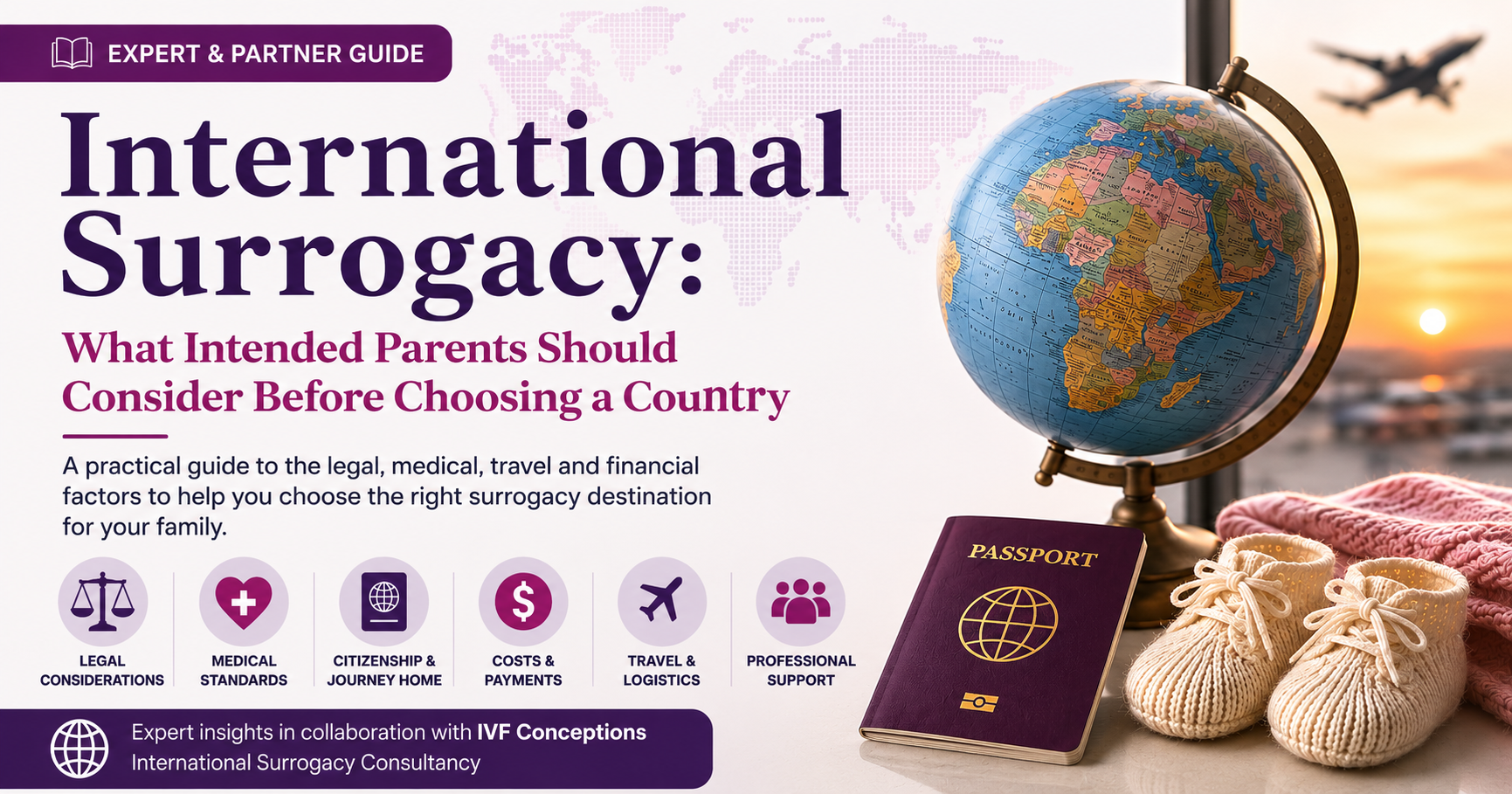
Choosing to build your family through international surrogacy is a major decision. Choosing where to pursue that journey can be just as important.
Many intended parents begin by comparing costs. That is understandable, because surrogacy can involve a significant financial commitment. But price is only one part of the decision. The country you choose can affect legal parenthood, eligibility, medical care, the surrogate's rights and support, travel requirements, citizenship and the process for bringing your child home.
There is no single international surrogacy law. Every destination has its own legal framework, court decisions, administrative procedures and medical practices. The right destination therefore depends on the intended parents' nationality, marital status, family structure, medical circumstances, use of donor gametes, risk tolerance and home-country law.
Why the Choice of Country Matters
A country can have experienced fertility clinics while still presenting legal uncertainty. Equally, a country may have legislation dealing with surrogacy but impose eligibility rules that do not fit every intended parent.
The most useful question is not simply, “Is surrogacy legal there?” It is, “Is this route legally and practically suitable for us, and will our home country recognise the parentage and citizenship route after the birth?”
Independent international guidance can help intended parents compare these factors. IVF Conceptions is an international surrogacy consultancy that works across multiple destinations and clinics. Its role is to help intended parents compare possible routes based on their circumstances rather than treating one country as suitable for everyone.
Confirm Eligibility Before Comparing Programmes
Surrogacy eligibility varies significantly between jurisdictions. Some destinations may restrict access by marital status, medical indication, genetic connection, citizenship or residence. Others may rely heavily on court decisions or administrative practice rather than a single comprehensive statute.
Before paying a deposit or moving embryos, ask:
- Is surrogacy permitted or recognised in the destination under current law and practice?
- Are foreign intended parents accepted?
- Do different rules apply to married couples, unmarried couples, single intended parents or LGBTQ+ families?
- Is a genetic link to at least one intended parent required?
- Are there age, medical or documentation requirements?
- Could proposed legislation or a recent court decision affect an arrangement already underway?
General marketing statements are not enough. Eligibility should be confirmed for the intended parents' exact circumstances by lawyers who understand both the destination country and the intended parents' home country.
Understand How Legal Parenthood Is Established
Legal parenthood is one of the most important questions in any international surrogacy journey. The process can differ considerably from one jurisdiction to another.
In Georgia, for example, Article 143 of the Law on Health Care provides for surrogacy in specified circumstances and states that when a child is born under that provision, the couple is deemed to be the parents and the surrogate does not have the right to be recognised as a parent. However, intended parents should still obtain current advice about eligibility, registration and the treatment of foreign families.
In Mexico, the legal picture is more fragmented. The Supreme Court has recognised important constitutional principles concerning reproductive autonomy, equality and filiation in cases involving surrogacy, but practical rules can differ by state and individual circumstances. Intended parents should not assume that one court decision creates a single nationwide process.
In Colombia, the Constitutional Court has repeatedly highlighted the absence of comprehensive national legislation and in 2024 again called on the government and Congress to regulate surrogacy. This means that careful legal advice is particularly important.
Before choosing a country, ask:
- Who is legally recognised as the parent or parents at birth?
- What documents are issued immediately after birth?
- Is a court order or further legal process required?
- What consent is required from the surrogate?
- How is parenthood recognised in the intended parents' home country?
- What happens if documents, registration or court procedures are delayed?
Plan for Citizenship, Passports and the Journey Home
A foreign birth certificate does not automatically mean a child can immediately obtain the intended parents' nationality, a passport or permission to travel.
Citizenship usually depends on the law of the intended parents' home country and, in some cases, the genetic relationship between parent and child. Additional evidence such as DNA testing, birth records, surrogacy agreements, court orders or embassy documentation may be required.
Government guidance in countries such as the United Kingdom and Australia specifically warns intended parents that international surrogacy can involve complex parentage, citizenship and travel-document issues and that families may need to remain abroad longer than expected.
Before treatment begins, establish:
- Which citizenship route is expected to apply to the child?
- What evidence will the relevant embassy or passport authority require?
- Whether DNA testing is likely to be required?
- How long post-birth documentation normally takes?
- Whether any additional parentage process is required after returning home?
Understand Compensation and Payment Rules
Some destinations permit compensated surrogacy, while others restrict payments to reasonable expenses or prohibit commercial facilitation. Intended parents must understand both the destination country's rules and any restrictions that apply to them at home.
For example, the United Kingdom allows surrogacy but does not allow commercial surrogacy arrangements to be organised for profit within the UK, and UK surrogates may generally receive reasonable expenses rather than a commercial fee. Australia prohibits commercial surrogacy, and some Australian states and territories also restrict residents from entering commercial arrangements overseas.
Payment rules affect more than the budget. They can influence the structure of the agreement, the role of intermediaries, court scrutiny and the intended parents' later parentage application.
Ask for a written breakdown of compensation, reimbursed expenses, insurance, medical costs, legal fees and agency charges. Vague or undocumented payment arrangements are a reason to pause and obtain independent advice.
Evaluate Medical and Clinical Standards
Legal clarity matters, but so does medical quality. The health of the surrogate and the future child depends on the quality of fertility treatment, prenatal care and delivery services.
Look into:
- The clinic's licensing or accreditation and experience with international patients
- The medical screening used for surrogates
- Embryology laboratory standards and embryo-storage procedures
- Approaches to embryo transfer and multiple-pregnancy risk
- Availability of prenatal, emergency and neonatal care
- How medical records are shared with intended parents and independent doctors
- Whether interpretation and translation are available when needed
Published success rates should be interpreted carefully. Ask for data relevant to the intended parents' age, embryo source, donor use and treatment history rather than relying on one headline percentage.
Consider Travel, Logistics and Length of Stay
International surrogacy can involve more travel than intended parents initially expect. Some journeys require visits for treatment, legal appointments or the birth, while others involve a longer post-birth stay while citizenship or travel documents are processed.
Plan for:
- The number and timing of expected trips
- Visa requirements for the intended parents
- Whether attendance at the birth is required or strongly recommended
- The likely post-birth stay
- Accommodation, local transport and translation
- Travel or security disruption
- The possibility of a premature birth or extended neonatal care
A realistic contingency budget is important. The cheapest programme can become significantly more expensive if travel, legal or medical delays are not included in the initial estimate.
Check the Professional Support Network
A country may have a workable legal framework, but the quality of the professionals coordinating the journey still matters.
Before committing, establish:
- Who represents the intended parents legally?
- Whether the surrogate receives genuinely independent legal advice?
- Which clinic and hospital will provide treatment and care?
- Who is responsible for coordination during pregnancy and emergencies?
- How complaints or disagreements are handled?
- Whether the agency or consultant's relationships with clinics and lawyers can be verified?
Separate legal representation is an important safeguard. The intended parents and surrogate can share a goal while still having different legal interests.
Monitor Legal and Political Stability
Surrogacy rules can change. A programme that was available to foreign intended parents several years ago may not operate the same way today.
Ask how long the current legal framework has been in place, whether major changes are being proposed, and what protections or contingency plans apply if rules change after treatment has started.
This is particularly important where the legal route depends heavily on administrative practice or court decisions rather than a comprehensive national statute.
Current International Destinations: A Cautious Overview
The following examples illustrate why country-by-country research matters. They are not recommendations and should not be treated as a substitute for current legal advice.
Georgia
Georgia has a statutory provision dealing with gestational surrogacy. Article 143 of its Law on Health Care provides that, in the circumstances described by the law, the couple is treated as the parents and the surrogate does not have the right to be recognised as a parent.
However, intended parents should confirm current eligibility and administrative practice immediately before entering a programme, particularly if they are foreign nationals. Policy proposals concerning international access have been discussed in recent years, making up-to-date advice essential.
Mexico
Mexico does not have one simple nationwide surrogacy pathway. State law, constitutional principles and court decisions can all be relevant. The Mexican Supreme Court has recognised reproductive autonomy and non-discrimination principles in surrogacy-related cases, including cases involving same-sex intended parents.
That does not mean every state follows the same process. Intended parents should obtain advice specific to the state where treatment, the agreement and the birth will take place.
Colombia
Colombia does not currently have a comprehensive national statute regulating surrogacy. The Constitutional Court has recognised that surrogacy occurs in practice but has repeatedly urged Congress to legislate, highlighting risks involving legal parentage, identity, exploitation and the rights of women and children.
Because the framework remains incomplete, intended parents need particularly careful advice on contracts, parentage, birth registration and citizenship.
Armenia
Armenia has legislation regulating assisted reproduction and surrogacy. The law applies in general to Armenian citizens, foreign citizens lawfully present in Armenia and stateless persons, subject to specific exceptions.
The current legislation contains detailed rules on who may act as a surrogate, medical screening and notarised agreements. It also includes restrictions affecting the use of Armenian-citizen surrogates by certain foreign intended parents. These details make individual legal review essential rather than relying on a general statement that Armenia is simply “open” or “closed” to foreign intended parents.
Do Not Choose a Country on Cost Alone
International programmes can sometimes appear substantially less expensive than surrogacy in the United States, but advertised package prices are difficult to compare directly.
One quotation may include surrogate compensation, insurance, legal work and multiple embryo transfers, while another may exclude them. Currency movements, donor eggs, neonatal care, additional transfer attempts, travel and post-birth legal work can also change the final cost.
Instead of relying on a headline price, request a written cost schedule covering:
- Agency or coordination fees
- Surrogate compensation and reimbursable expenses
- Medical screening and IVF treatment
- Donor eggs or sperm where relevant
- Embryo testing and storage
- Insurance and pregnancy-related medical care
- Legal fees in every relevant jurisdiction
- Travel and accommodation
- Post-birth documents, translation and certification
- Potential additional embryo transfers or pregnancy complications
A Step-by-Step Approach Before Committing
Before selecting a country, clinic, agency or surrogate, intended parents should obtain advice that considers their specific nationality, family structure, medical circumstances and home-country law.
A sensible order is:
- Confirm legal eligibility in the proposed destination.
- Confirm how parenthood and citizenship will work at home.
- Review the medical pathway and clinic.
- Understand how the surrogate is screened, advised and supported.
- Review the complete budget and contingency costs.
- Confirm the post-birth documentation and travel plan.
- Only then sign contracts, transfer embryos or make major payments.
Take Your Time
Choosing a surrogacy destination is one of the first major decisions in an international journey. It should not be made from a price comparison or an agency marketing page alone.
Read the current legal framework. Ask direct questions. Use independent lawyers. Verify medical and professional credentials. Understand how your child will obtain parentage recognition, citizenship and travel documents.
International surrogacy can offer intended parents a route to building their family, but careful country selection creates a much stronger foundation for the medical, legal and emotional journey that follows.
Frequently Asked Questions
Which countries currently allow international surrogacy?
There is no single list that is safe to rely on for every intended parent. Availability depends on local law, nationality, family structure, medical circumstances and administrative practice. Rules can change quickly, so current legal advice is essential before starting treatment.
Is Georgia, Mexico, Colombia or Armenia the best option for everyone?
No. Each destination has different strengths, restrictions and uncertainties. What works for one family may not be suitable for another.
Will my child automatically receive my citizenship if born abroad through surrogacy?
Not necessarily. Citizenship depends on the relevant nationality laws and may require additional evidence or procedures. Intended parents should establish the citizenship and passport route before treatment begins.
Is compensated surrogacy legal everywhere?
No. Some jurisdictions allow compensation, some limit payments to reasonable expenses, and others prohibit commercial surrogacy or commercial facilitation. The rules in the intended parents' home country may also matter.
Can surrogacy laws change after I have started the process?
Yes. Surrogacy laws and administrative policies can change. Intended parents should work with professionals who monitor developments and can explain what would happen if rules change during an ongoing journey.
Expert Contribution
This guide was prepared in collaboration with IVF Conceptions, an international surrogacy consultancy.
This article provides general educational information only and is not medical, legal, immigration, psychological or financial advice. Surrogacy laws and professional requirements can change and vary according to individual circumstances.