
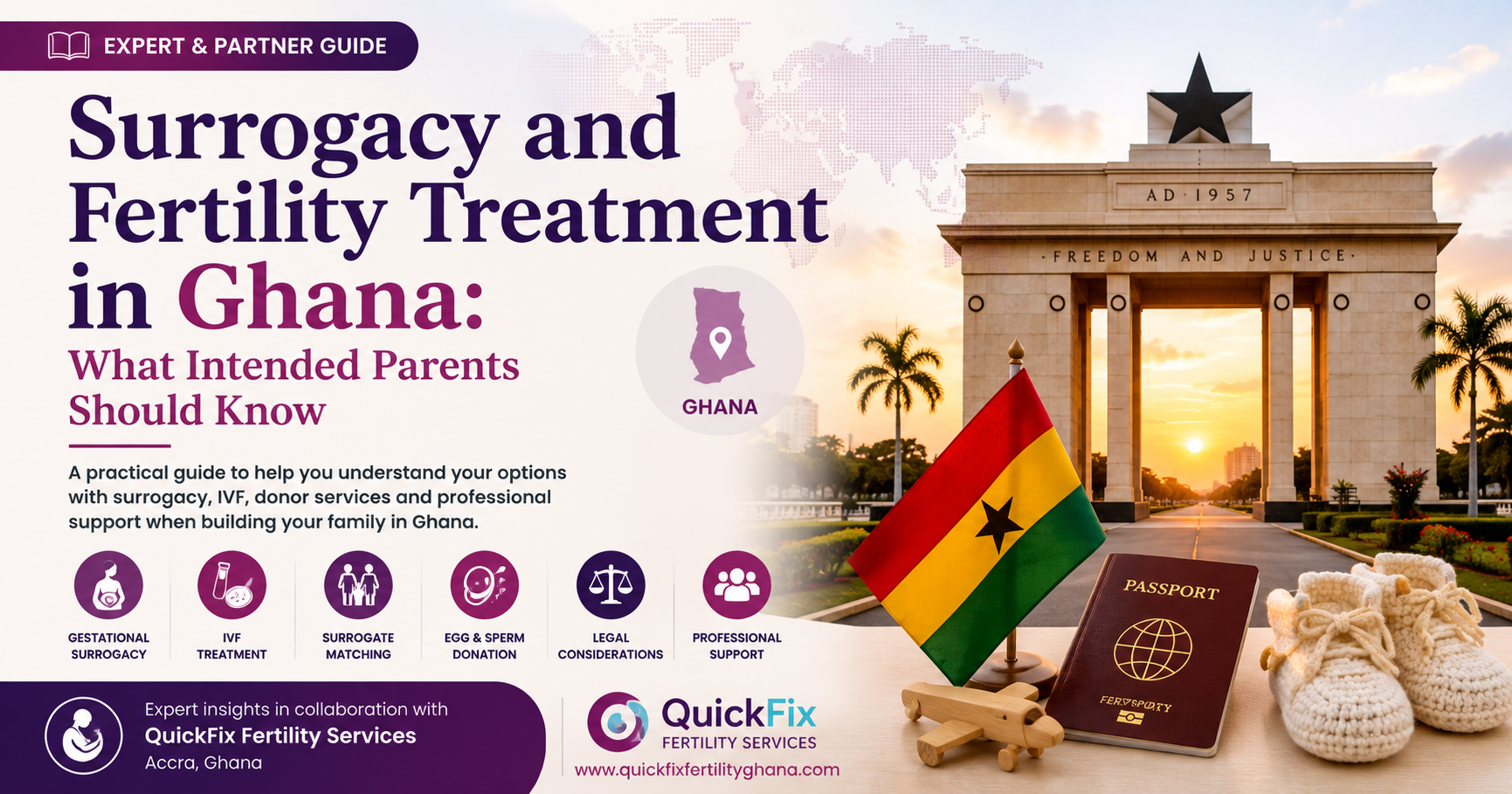
For intended parents exploring different ways to build their family, Ghana is becoming part of a wider conversation around fertility treatment, donor conception and gestational surrogacy.
A successful fertility journey, however, involves much more than simply finding a surrogate or choosing a fertility treatment. Intended parents need to understand the medical process, consider whether donor eggs or sperm may be required, find the right people to support their journey and obtain appropriate professional and legal advice.
For those considering Ghana, understanding these different parts of the process before making decisions can make the journey considerably easier to navigate.
Understanding Gestational Surrogacy
In gestational surrogacy, an embryo created through IVF is transferred to a gestational surrogate, who carries the pregnancy on behalf of the intended parent or parents.
Depending on the circumstances, embryos may be created using the intended parents' own eggs and sperm or with the assistance of an egg or sperm donor.
This means surrogacy and fertility treatment are often closely connected. Intended parents may need support from fertility professionals, a surrogate, donor services and other specialists during different stages of the journey.
Finding the Right Surrogate
Finding a potential surrogate is an important first step, but a successful match involves much more than simply identifying someone who is willing to carry a pregnancy.
Intended parents and potential surrogates should have open conversations about expectations, communication, pregnancy-related decisions and the type of relationship both parties would like during and after the journey.
Compatibility matters.
Medical assessment and appropriate screening should also form part of the process before treatment begins.
Some intended parents choose to search independently for potential surrogates, while others prefer to work with an organisation that can help coordinate the process.
Whichever route is chosen, nobody should feel pressured to proceed with a match before they are comfortable.
The Role of IVF
IVF is generally central to a gestational-surrogacy journey.
The precise treatment pathway will depend on individual circumstances and whether the intended parents are using their own eggs and sperm or require donor assistance.
Fertility professionals can assess the intended parents' circumstances and explain the appropriate medical options before embryos are created and an embryo transfer is planned.
Because every case is different, intended parents should avoid assuming that another person's IVF or surrogacy experience will necessarily be the same as their own.
Egg and Sperm Donation
Some intended parents pursuing surrogacy may also require an egg donor or sperm donor.
Choosing a donor can be a very personal decision. Intended parents may consider factors including medical and family history, physical characteristics and other information available about a prospective donor.
Appropriate medical screening and professional guidance are important parts of donor-assisted reproduction.
Using donor eggs or sperm also introduces additional emotional, medical and potentially legal considerations, so intended parents should understand the implications before proceeding.
Fertility and Surrogacy Support in Ghana
QuickFix Fertility Services, based in Accra, Ghana, provides fertility and family-building support including gestational surrogacy, surrogate matching, egg and sperm donor assistance and IVF support services.
The organisation's approach includes assessing the requirements of intended parents and helping connect them with suitable surrogates or donors, alongside support throughout the fertility journey.
Intended parents interested in learning more about the services available in Ghana can visit QuickFix Fertility Services for further information.
Consider the Legal Side Early
Surrogacy can involve significant legal questions, particularly where intended parents live in a different country from the surrogate.
The rules surrounding legal parenthood, birth registration, citizenship, immigration and the recognition of surrogacy arrangements can vary considerably between jurisdictions.
International intended parents should therefore obtain independent legal advice from appropriately qualified professionals familiar with the relevant jurisdictions before committing to treatment or a surrogacy arrangement.
Legal arrangements should not be treated as something to deal with only after a pregnancy has begun.
Communication Is an Important Part of the Journey
A surrogacy journey can last many months and involves important decisions for everyone involved.
Clear communication between intended parents, the surrogate and the professionals supporting the journey can help establish expectations from the beginning.
Discussions may include how frequently everyone expects to communicate, attendance at medical appointments, how pregnancy updates will be shared and expectations surrounding the birth.
These conversations can sometimes feel detailed at the beginning of a relationship, but establishing expectations early can prevent misunderstandings later.
Starting Your Journey
There is no single route to parenthood through surrogacy.
Some intended parents begin by researching fertility clinics. Others start by searching for a surrogate, investigating donor options or speaking with a fertility or surrogacy organisation.
The important thing is not to rush.
Research the available options, ask questions, speak openly with prospective surrogates and donors, and obtain appropriate medical and legal guidance before making commitments.
For intended parents considering Ghana, organisations with local fertility and surrogacy experience can provide valuable insight into the practical aspects of pursuing treatment in the country.
Surrogacy is ultimately a collaborative journey involving intended parents, surrogates, fertility professionals and, in some cases, egg or sperm donors. Taking the time to understand each part of that journey can help intended parents move forward with greater confidence.
Expert Contribution
This article was produced in collaboration with QuickFix Fertility Services in Accra, Ghana. QuickFix provides gestational surrogacy, surrogate matching, egg donor, sperm donor and IVF support services.
This article provides general information only and should not be considered medical or legal advice. Surrogacy laws, eligibility requirements and professional procedures can change, and intended parents should obtain advice relevant to their individual circumstances.