
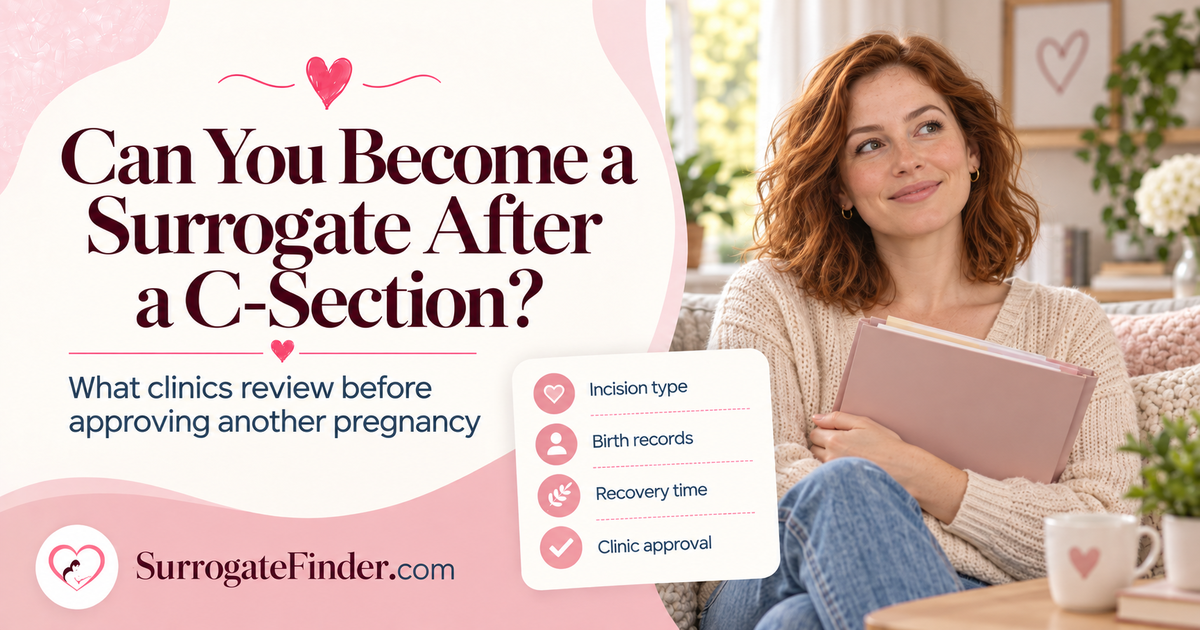
Yes, it may be possible to become a gestational surrogate after a C-section. One previous uncomplicated caesarean birth does not automatically disqualify someone, particularly when the uterus healed well and later medical review finds no significant concerns.
Approval is never based on the skin scar alone. A fertility clinic reviews the uterine incision, reason for the C-section, number of previous caesareans, time since delivery and any complications involving bleeding, infection, the placenta or recovery.
Every clinic and surrogacy programme sets its own criteria. A person who appears suitable at registration must still receive individual medical clearance before medication or embryo transfer.
The short answer
A previous C-section often does not prevent someone from becoming a surrogate. Many people have healthy pregnancies after one caesarean delivery.
However, a C-section creates a scar in the uterus. Another pregnancy can place stress on that scar and may carry additional risks, including uterine rupture and certain placental complications. The level of risk depends on the type and location of the uterine incision, the number of operations and the person’s complete obstetric history.
Why clinics review a previous C-section carefully
A caesarean section is major abdominal surgery. The visible scar on the abdomen does not necessarily show how the uterus was opened, repaired or healed.
Clinics assess whether another pregnancy would present an acceptable risk to the prospective surrogate. They also need to understand how a previous C-section may affect antenatal monitoring and delivery planning.
The decision protects the surrogate first. Intended parents’ preferences, available embryos or a successful profile match cannot replace medical clearance.
The uterine incision matters more than the skin scar
Most modern C-sections use a low-transverse uterine incision, a horizontal cut in the lower part of the uterus. This type of incision generally has a lower risk of rupture in a future labour than a classical vertical incision in the upper uterus.
The abdominal skin scar can run in a different direction from the incision in the uterus. Looking at the outside scar is therefore not enough to determine eligibility.
The operative report from the previous delivery is the most useful record because it may state the uterine incision, reason for surgery, complications and repair. If records are unavailable, the clinic may request further information or make a cautious decision based on the available evidence.
What is a classical C-section incision?
A classical C-section uses a vertical incision in the upper muscular part of the uterus. It is different from a vertical skin scar and is less common than a low-transverse uterine incision.
A classical incision has a higher risk of opening in a later pregnancy or labour. It can substantially affect delivery planning and may make someone unsuitable for gestational surrogacy under a clinic’s policy.
Only medical records and clinical assessment can confirm the incision type. A prospective surrogate should not assume it from the appearance of her abdomen.
Does the number of previous C-sections matter?
Yes. Risks associated with uterine scarring can increase with repeated caesarean deliveries. These can include adhesions, surgical injury, heavy bleeding and abnormal attachment of the placenta.
Some programmes accept applicants with one previous C-section and may consider more than one after specialist review. Others set a strict maximum number of previous caesareans or total births.
There is no single worldwide limit that applies to every surrogate. The answer depends on the clinic, local professional guidance and the individual medical history.
How long should you wait after a C-section?
The uterus and the rest of the body need time to recover after pregnancy and surgery. Starting another pregnancy too soon may increase the likelihood of complications.
Clinics commonly require a recovery interval before screening or embryo transfer, but the exact period varies. The recommended wait can be longer when there was infection, severe bleeding, poor wound healing, preterm birth or another significant complication.
A person should not use a general online timeframe as personal clearance. Her obstetrician and fertility clinic should review recovery and future pregnancy plans.
What records will the fertility clinic request?
A clinic may ask for:
- The C-section operative report
- Prenatal and hospital records
- The discharge summary
- Records of postpartum appointments
- Details of infection, bleeding or readmission
- The baby’s gestational age and birth outcome
- Information about other pregnancies and deliveries
Obtaining records early can prevent delays. Applicants should disclose all previous pregnancies, losses, procedures and complications, even when these occurred many years ago.
Why was the previous C-section needed?
The reason for the operation helps the clinic understand whether the issue is likely to recur.
A C-section for a one-time circumstance, such as breech presentation, may be assessed differently from surgery associated with serious high blood pressure, placental disease, obstructed labour or another ongoing condition.
The reason alone does not decide eligibility. The clinic considers it alongside the uterine incision, recovery, current health and all previous birth outcomes.
Placental risks after a C-section
A previous uterine scar can affect where and how the placenta attaches in a later pregnancy. Conditions of concern include placenta previa, where the placenta lies low and may cover the cervix, and placenta accreta spectrum, where placental tissue attaches too deeply to the uterine wall.
These conditions are not inevitable. Their likelihood is influenced by factors including the number of previous caesareans and whether placenta previa is present.
Placental problems can cause severe bleeding and may require planned specialist care or early delivery. A previous C-section should therefore be included in medical records and discussed during antenatal care.
What is the risk of uterine rupture?
Uterine rupture means that a scar in the uterus opens during pregnancy or labour. It is uncommon but serious and requires urgent treatment.
Risk varies according to incision type, previous uterine surgery, number of scars and whether labour is attempted or induced. A low-transverse scar generally carries less risk than a classical incision.
The fertility clinic and maternity team should discuss how the previous operation affects monitoring and delivery options. Surrogacy agreements should not try to predetermine a delivery method regardless of medical circumstances.
Could scar tissue affect embryo transfer?
Most people with a previous C-section can undergo embryo transfer without difficulty. The embryo is placed inside the uterine cavity using a thin catheter, without cutting through the uterine scar.
Some people develop a caesarean scar defect, sometimes called a niche, or adhesions after surgery. These findings may be associated with unusual bleeding, fluid in the uterine cavity or technical concerns.
The clinic may assess the uterus with ultrasound or another procedure before approving transfer. Our guide What Happens During an Embryo Transfer to a Surrogate? explains the transfer process.
Does a previous C-section affect fertility?
Most people who have had a C-section can become pregnant again. The operation does not normally prevent the ovaries from releasing eggs.
Uncommon complications such as serious infection, adhesions or a scar defect may affect fertility or pregnancy. Age and unrelated reproductive conditions can also change over time.
In gestational surrogacy, the surrogate’s own egg is not used, but the uterus must still be suitable to receive an embryo and carry a pregnancy. Read Does Being a Surrogate Affect Your Fertility? for more detail.
Will another C-section be required?
Not always. Some people may be candidates for a vaginal birth after caesarean, often called VBAC, while others are advised to have a planned repeat C-section.
The safest approach depends on the previous uterine incision, reason for the first C-section, number of earlier operations, current pregnancy and capabilities of the maternity unit. Plans may also change if complications develop.
The surrogate should make delivery decisions with her maternity team through informed consent. Intended parents can be included in respectful planning, but they do not control the surrogate’s medical decisions.
Previous complications that may affect approval
A clinic may require specialist review or decline an applicant after complications such as:
- A classical or other high-risk uterine incision
- Uterine rupture or major uterine surgery
- Placenta accreta spectrum
- Severe postpartum haemorrhage
- Serious infection or sepsis
- Significant surgical injury
- Severe pre-eclampsia or another major pregnancy disorder
- Very preterm delivery
- Poor healing or continuing symptoms
This list is not a universal set of exclusions. The severity, cause, recurrence risk and current medical findings all matter.
Other surrogate eligibility requirements
A C-section history is only one part of screening. Programmes may also consider:
- At least one previous healthy pregnancy and birth
- Age and general physical health
- Body mass index under the clinic’s policy
- Smoking, alcohol and drug use
- Current medication and health conditions
- Mental-health and postpartum history
- A stable living situation and reliable support
- Infectious-disease screening
- Willingness to follow treatment and antenatal care
Requirements differ across locations. A matching platform can help people connect, but only qualified professionals can provide medical and legal clearance.
How to prepare for surrogate screening
- Request your previous maternity and operative records.
- Write down every pregnancy, delivery and complication.
- Complete postpartum follow-up and address persistent symptoms.
- Allow the recovery period advised by your healthcare team.
- Discuss whether you want more children of your own.
- Ask how the clinic evaluates previous caesareans.
- Obtain independent legal advice before making commitments.
Do not minimise a complication to improve the chance of acceptance. Complete information allows the clinic to make a safer decision.
Questions to ask the fertility clinic
- Do you accept surrogates after one or more C-sections?
- Which records do you need from my previous delivery?
- Does my uterine incision type meet your policy?
- Will you assess the C-section scar before embryo transfer?
- How long must I wait after delivery?
- Would I need review by a maternal-fetal medicine specialist?
- How could another pregnancy affect placental or delivery risks?
- What care is covered if a complication occurs?
Insurance and legal planning after a C-section
The parties should understand how prenatal care, specialist appointments, delivery and complications will be funded. Insurance terms vary and exclusions should be reviewed by an appropriate professional.
The legal agreement should address expenses, bed rest, lost income, childcare, travel, invasive procedures and emergency situations. It must respect the surrogate’s bodily autonomy and right to make informed medical decisions.
Independent legal representation is important because the surrogate and intended parents have different interests.
Finding intended parents after medical clearance
Once you understand your health history and are ready to explore a match, SurrogateFinder can help you connect with intended parents. It is a matching platform rather than a fertility clinic, agency or legal practice.
You can browse intended-parent profiles or create a free surrogate profile. Share sensitive medical records only through appropriate secure professional channels, not in a public profile.
Frequently asked questions
Can I be a surrogate after one C-section?
Possibly. One uncomplicated low-transverse C-section often does not automatically exclude an applicant, but the fertility clinic must review the operative report and complete pregnancy history.
Can I be a surrogate after two C-sections?
Some clinics may consider it and others may not. Repeated caesareans can increase certain risks, so policies and individual specialist assessments differ.
How can I find out which uterine incision I had?
Request the operative report from the hospital where the C-section was performed. The skin scar alone cannot reliably identify the uterine incision.
Will the clinic examine my C-section scar?
The clinic may evaluate the uterus and scar area with ultrasound or another test. The exact screening protocol varies.
Do I have to give birth by C-section again?
Not necessarily. Some people can consider VBAC, while others are advised to have a repeat C-section. The maternity team makes an individual recommendation.
Can a C-section scar stop an embryo implanting?
Most people with a previous C-section can receive an embryo normally. A scar defect or fluid in the uterine cavity may require further assessment before transfer.
How soon after a C-section can I apply to be a surrogate?
Programmes require adequate physical recovery and set their own minimum intervals. Ask your obstetrician and fertility clinic rather than relying on a universal timeframe.
Can an intended parent decide how I give birth?
No. Birth preferences can be discussed, but medical decisions require the surrogate’s informed consent and should be made with her healthcare team.
The bottom line
A C-section does not automatically end the possibility of becoming a gestational surrogate. Many applicants with one well-healed low-transverse uterine scar may still qualify.
Eligibility depends on much more than the number of scars. The clinic needs to review the uterine incision, operative records, reason for surgery, recovery, placental history and all other pregnancies.
Gather your records and seek individual medical advice before matching or agreeing to a transfer. A careful review provides a safer basis for both the surrogate and intended parents.
This article provides general information and is not medical or legal advice. Surrogacy eligibility criteria and laws differ by clinic and location. Seek advice from qualified healthcare and legal professionals.