
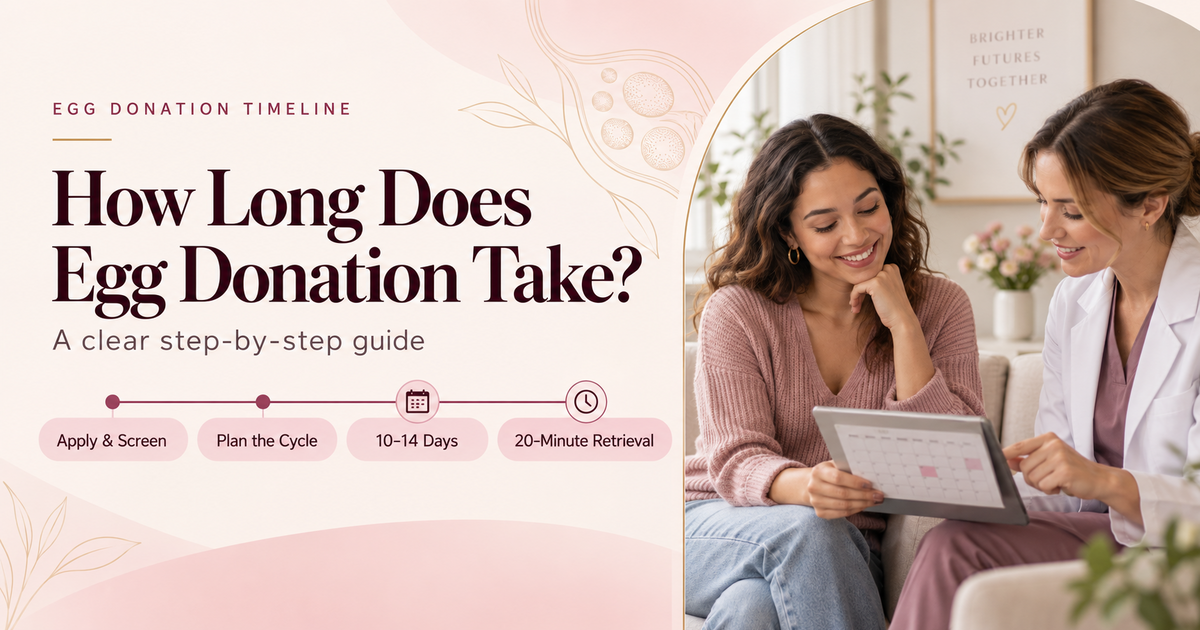
Egg donation is not a single appointment. From the first application to egg retrieval, the process often takes around two to three months, although the exact schedule depends on the clinic, screening requirements, matching arrangements and the donor's response to medication. The active treatment phase is much shorter: ovarian stimulation commonly lasts about 10 to 14 days, followed by a brief outpatient egg retrieval.
The short answer: Allow roughly two to three months from initial contact with a clinic to egg collection. Within that window, expect consultations and screening, cycle planning, around 10 to 14 days of medication and monitoring, then retrieval and a short recovery period.
This guide breaks down the timeline step by step. It describes a typical process, not a guaranteed schedule. Your fertility clinic's instructions always take priority because protocols, donor rules and appointment availability differ by country and provider.
Egg donation timeline at a glance
- Application and initial review: a few days to several weeks
- Medical, genetic and psychological screening: several weeks, depending on appointments and test results
- Matching and legal or administrative steps: highly variable
- Cycle planning: often one menstrual cycle, but clinic protocols differ
- Ovarian stimulation and monitoring: commonly about 10 to 14 days
- Trigger medication: usually timed about 34 to 36 hours before retrieval
- Egg retrieval: commonly around 20 minutes, plus preparation and recovery time at the clinic
- Initial recovery: many donors rest for the remainder of the day and resume light activities within a few days, as advised by their clinic
If you want an overview of what happens medically, read how egg donation works. The sections below focus specifically on how long each part may take.
Stage 1: Application and initial consultation
The first stage usually starts with an online form or an enquiry to a fertility clinic, egg bank or donor programme. You may be asked about your age, health, pregnancy history, lifestyle, education, interests and family medical background. Some programmes review applications within days, while others may take longer because of application volume or eligibility checks.
If the initial information appears suitable, the programme normally arranges an introductory call or consultation. This is the time to ask about the full schedule, compensation or expenses, travel, required appointments, legal arrangements, anonymity rules and what happens if a cycle is postponed or cancelled.
Eligibility criteria vary. Before applying, review the typical egg donor requirements, but remember that only a clinic can decide whether someone is medically suitable to proceed.
Stage 2: Donor screening
Screening is often the most appointment-heavy part before treatment begins. It may include a medical history review, physical examination, ovarian reserve testing, ultrasound scans, infectious-disease testing, genetic carrier screening and counselling or psychological assessment. Some programmes also require records from a primary-care doctor or additional information about family health history.
This stage can take several weeks because appointments must be coordinated and laboratory results returned. A repeat test, an incomplete family history or a request for specialist review can extend the timeline. Screening is not a formality: it is intended to protect the donor, recipients and any child who may be born from the donation.
Not every applicant is approved, and a decision not to proceed does not necessarily mean that the applicant is generally unhealthy. Donation involves a specific medication cycle and procedure, so clinics use criteria designed for that context.
Stage 3: Matching, counselling and administration
The length of the matching stage depends on the type of programme. A donor who is already known to the intended parents may move differently from someone joining a database and waiting to be selected. A fresh donation cycle may also require more coordination than a programme that freezes eggs for later use.
Depending on local law and clinic policy, this stage may include counselling, consent forms, legal advice, contracts, identity-release choices, expenses or compensation arrangements and travel planning. These steps should be completed carefully rather than rushed. If compensation is part of the arrangement, our guide to how much egg donors get paid explains why amounts and rules vary.
Stage 4: Planning the treatment cycle
Once the donor is cleared and the administrative steps are complete, the clinic creates an individual treatment calendar. The starting date may be linked to the donor's menstrual cycle. Some protocols use hormonal medication before stimulation begins; others do not. In a fresh donor cycle, the clinic may also coordinate the donor's timing with the recipient's treatment.
A planned start can move if a period arrives earlier or later than expected, baseline hormone levels are not suitable, an ovarian cyst is seen, medication delivery is delayed or the clinic needs to adjust scheduling. Donors should avoid booking non-refundable travel or major commitments until the clinic confirms the key dates.
Stage 5: Around 10 to 14 days of stimulation and monitoring
During ovarian stimulation, the donor takes prescribed hormone injections to encourage several follicles to develop. The medication phase commonly lasts about 10 to 14 days, but the dose and duration are personalised. The clinic monitors progress with ultrasound scans and blood tests, often more frequently as retrieval approaches.
This is usually the least flexible part of the schedule. Monitoring appointments may be early in the morning, and the clinic can change medication doses or the expected retrieval date at short notice. Donors need to take each medicine exactly as directed and remain available for appointments.
Many donors experience temporary effects such as bloating, pelvic heaviness, fatigue, headaches, mood changes or tenderness. For a balanced explanation of comfort and symptom management, see is egg donation painful? and egg donation risks and side effects.
Stage 6: Trigger medication and egg retrieval
When the follicles are ready, the clinic gives precise instructions for the final trigger medication. It is commonly scheduled about 34 to 36 hours before egg retrieval. Timing matters, so donors should confirm the exact time and contact number in case a dose is late, missed or taken incorrectly.
The retrieval itself is usually brief. It commonly takes around 20 minutes and is performed with sedation or anaesthesia, depending on the clinic. However, the donor will spend longer at the facility for admission, preparation, the procedure and observation afterwards. The clinic will normally require a responsible adult to take the donor home, and driving is generally not allowed after sedation.
The number of eggs collected cannot be guaranteed. It depends on how the ovaries respond and how many mature eggs are available on the day. A clinic may occasionally recommend cancelling a cycle before retrieval if the response is considered unsafe or unlikely to produce an appropriate outcome.
Stage 7: Recovery after egg collection
Plan to rest for the remainder of retrieval day. Cramping, spotting, bloating and tiredness can occur. Some donors feel ready for desk-based work or light activities after a day or two, while others need more time. Jobs involving lifting, prolonged standing or strenuous exercise may require a longer break.
The clinic will provide specific restrictions and warning signs. Seek prompt medical advice for severe or worsening pain, heavy bleeding, faintness, breathing difficulty, rapidly increasing abdominal swelling, persistent vomiting, reduced urination or any symptom the clinic has told you to report. Recovery should be guided by the medical team rather than by a fixed online timetable.
What can delay the egg donation process?
Even a well-planned cycle can change. Common reasons include:
- waiting for medical records, laboratory results or genetic counselling
- repeat screening tests or an additional specialist opinion
- matching delays or changes in the intended parents' plans
- legal, consent, insurance or payment administration
- travel documents and appointment availability
- changes in the donor's menstrual cycle or baseline scan
- illness, medication changes or a new health concern
- a lower or higher than expected response to stimulation
- clinic laboratory schedules, holidays or capacity
A delay is not always a sign that something has gone wrong. Fertility teams may pause or modify a cycle to prioritise safety and give treatment the best chance of proceeding appropriately.
How much time off work should an egg donor plan?
There is no single answer, because work duties, travel distance and individual recovery differ. At minimum, plan for screening visits, several monitoring appointments during stimulation, the full retrieval day and transport home. It is sensible to keep the following day flexible. Donors with physically demanding jobs may need additional time or temporary restrictions.
Ask the clinic how many visits are typical, how much notice they give for retrieval, whether monitoring can happen locally and whether they provide documentation for an employer. If travel is involved, allow extra time for pre-procedure appointments and do not assume you can fly or drive immediately after retrieval.
Questions to ask your clinic about the timeline
- What is your typical time from application to medical clearance?
- Do I wait to be matched before screening, or can screening begin first?
- How many in-person appointments should I expect?
- Can monitoring be completed near where I live?
- How much notice will I receive for the retrieval date?
- What could postpone or cancel the cycle?
- How long should I avoid work, travel, sex and strenuous exercise?
- Who do I call after hours if I have symptoms or a medication problem?
Finding an egg donation match
Timelines are easier to compare when expectations are clear from the beginning. SurrogateFinder lets intended parents search for egg donors and browse egg donor profiles. People considering donation can also create an egg donor profile to introduce themselves and explore possible connections.
Online matching is only one part of the journey. Medical screening, counselling, legal advice and treatment should be handled by appropriately qualified professionals in the relevant country or jurisdiction.
Frequently asked questions
How long does the whole egg donation process take?
A typical process may take around two to three months from first contacting a clinic to egg collection. Matching, complex screening, legal work or scheduling can make it longer.
How long do egg donation injections last?
Ovarian stimulation commonly lasts about 10 to 14 days. The exact duration and dose depend on the clinic's protocol and the donor's response, which is checked through scans and blood tests.
How long does egg retrieval take?
The procedure commonly takes around 20 minutes, but the full clinic visit is longer because it includes admission, preparation, sedation or anaesthesia and recovery observation.
How soon can an egg donor return to work?
Many donors return to light or desk-based activities within a few days, but recovery varies. The retrieval day must be kept free, and physically demanding work may require more time. Follow the clinic's individual advice.
Can the retrieval date change?
Yes. The final date depends on follicle growth and hormone levels during monitoring, so it may shift from the original estimate. Donors should keep the likely retrieval window flexible.
Does matching count in the timeline?
It depends on the programme. Some donors are fully screened before matching, while others complete later steps after being selected. Ask the programme which stages are included in its quoted timeframe.