
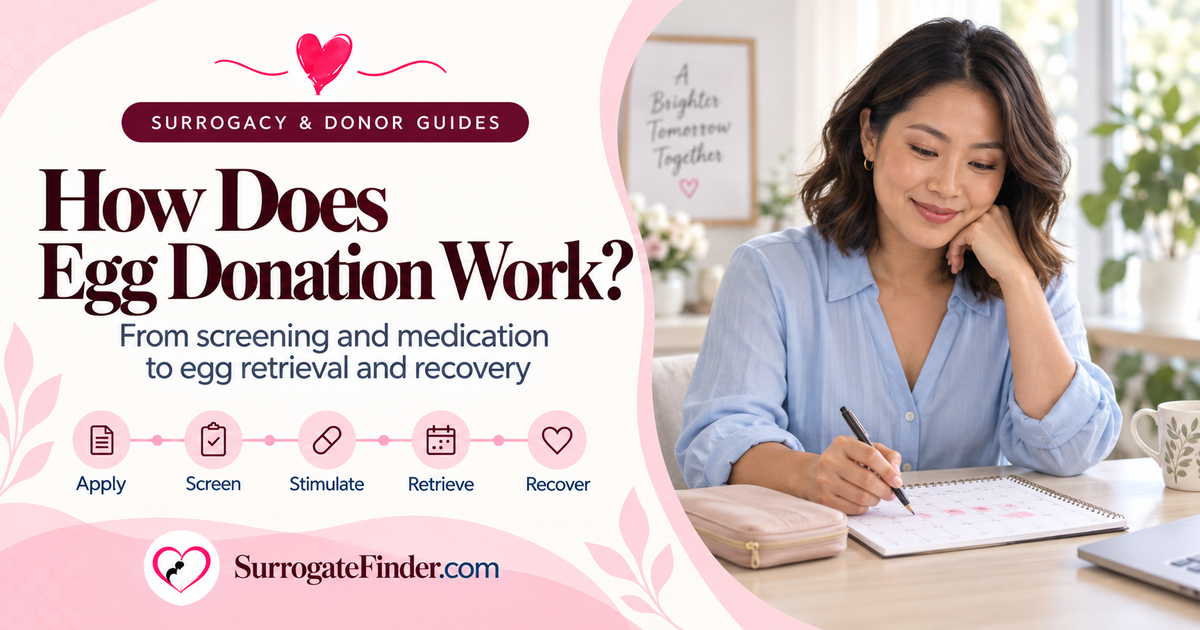
Egg donation is a process in which a donor completes medical and psychological screening, takes medication to help several eggs mature and attends a short procedure to collect those eggs. The eggs may then be fertilised with sperm through IVF and used to create embryos for an intended parent or recipient.
A donation cycle usually involves multiple clinic appointments over several weeks. The exact timetable, eligibility rules, compensation, legal rights and rules about identity vary by clinic and country.
Egg donation is not the same as surrogacy. An egg donor provides genetic material but does not carry the pregnancy. A gestational surrogate carries an embryo but normally provides neither the egg nor the sperm.
The short answer
The usual stages are application, record review, medical and genetic screening, counselling, legal consent, matching, ovarian stimulation, monitoring, a trigger injection, egg retrieval and recovery.
The laboratory assesses the collected eggs. Mature eggs may be fertilised immediately, frozen for future use or used under another plan agreed with the clinic. Donation does not guarantee that embryos or a pregnancy will result.
Why do people use donated eggs?
Donated eggs may help someone who cannot use their own eggs, has a risk of transmitting a serious inherited condition, has experienced age-related fertility decline or has had unsuccessful fertility treatment. They can also help male couples and some single intended fathers build a family with a gestational surrogate.
The treating clinic determines whether donor-egg IVF is appropriate for the recipient. This decision is separate from assessing whether an individual donor can participate safely.
Who can become an egg donor?
Programmes commonly set an age range and review general health, reproductive history, medication, body-mass index, smoking, alcohol and substance use. Criteria are not identical between clinics or jurisdictions.
A person should not assume that being young or having previously conceived guarantees acceptance. Clinics consider whether ovarian stimulation and retrieval are medically appropriate and whether the donor can give informed consent.
Starting an egg-donor application
An application may ask about education, interests, work, appearance, ethnicity, family background, previous pregnancies and reasons for donating. It can also request photographs and information that may later be shown to intended parents.
Applicants should answer accurately and ask who can view the information. A profile is part of matching, while the confidential medical record is handled separately.
Prospective donors can browse intended-parent profiles and create a free SurrogateFinder profile, but all treatment must still be managed by qualified professionals.
Medical-history screening
The clinic commonly reviews personal and family medical history. Questions may cover inherited conditions, cancer, heart disease, neurological illness, psychiatric history, pregnancy complications and known fertility problems.
Some programmes request records from a primary-care doctor or earlier fertility treatment. An uncertain family history does not always prevent donation, but it must be disclosed so the clinic and genetic counsellor can assess it.
Physical examination and fertility assessment
A clinician may perform a physical examination and record blood pressure, height and weight. Fertility assessment often includes a transvaginal ultrasound to view the ovaries and count visible follicles.
Blood tests may assess ovarian reserve or hormone levels. These results help the clinic estimate how the ovaries might respond to stimulation; they do not provide a complete prediction of future fertility.
Infectious-disease testing
Donors are screened for infections that could be transmitted through donated eggs or affect treatment. The panel and timing depend on applicable regulation and clinic policy, but may include HIV, hepatitis B, hepatitis C, syphilis, gonorrhoea and chlamydia.
Additional tests may be required according to location, travel, medical history or current public-health guidance. Some tests need to be performed or repeated within a defined period before retrieval.
Genetic carrier screening
Genetic screening can identify variants associated with inherited conditions. The clinic may use a standard panel, add tests based on ancestry or family history, and compare results with the sperm provider.
Being a carrier usually does not mean the donor has the condition. A genetic counsellor should explain what a result means, its limits and whether it has implications for the donor or her relatives.
Psychological assessment and counselling
Counselling helps a donor consider the emotional and long-term implications of providing eggs. Topics may include motivation, pressure, compensation, future contact, identity-release rules and the possibility that donor-conceived people may seek information later.
Direct-to-consumer DNA databases make permanent anonymity difficult to guarantee even where anonymous donation is permitted. Donors should consider this before treatment rather than relying solely on current paperwork.
Legal consent and independent advice
Consent forms address how eggs and embryos may be used, stored or discarded and what information can be released. Known or independently matched donations may also involve a separate legal agreement.
Parentage and donor rights vary by jurisdiction. Each party should obtain advice from a suitably qualified independent lawyer before medication begins. A matching platform cannot establish legal parentage or replace clinic consent.
How does matching work?
Intended parents may choose a donor through a clinic, egg bank, agency or independent matching platform. They might consider medical compatibility, ancestry, appearance, values, availability and whether future identity or contact is possible.
The donor should also decide whether the intended parents and proposed boundaries feel right. Our guide Surrogate Mother vs Egg Donor: What Is the Difference? explains the different roles.
Synchronising the treatment cycle
With a fresh donation, the clinic may coordinate the donor’s cycle with preparation of the recipient or gestational surrogate. Medication can be used to control timing.
With frozen eggs, fertilisation and embryo transfer can happen later. The donor’s retrieval and the recipient’s treatment therefore do not always occur during the same month.
Ovarian stimulation medication
During a typical cycle, the donor gives herself hormone injections for approximately one to two weeks. The medication encourages multiple follicles to develop instead of the single dominant follicle that often matures in an unmedicated cycle.
The clinic teaches injection technique, storage and timing. Medication should be taken exactly as prescribed because late or missed doses can affect safety and the treatment schedule.
Monitoring appointments
The donor attends ultrasound scans and blood tests while taking medication. These allow the clinic to measure follicle growth, check hormone levels and adjust doses.
Appointments may become more frequent near retrieval and can occur early in the day. Donors should understand the travel and work commitments before accepting a cycle.
The trigger injection
When the follicles appear ready, the clinic schedules a trigger injection that completes the final stage of egg maturation. It must usually be taken at a precise time because retrieval is planned a set number of hours later.
The donor should confirm the medication, dose, time and contact number for problems. She should not repeat or replace a missed dose without direct clinical instructions.
What happens during egg retrieval?
Egg retrieval is usually a short outpatient procedure performed with sedation or anaesthesia. Guided by transvaginal ultrasound, a clinician passes a needle through the vaginal wall to drain fluid from the ovarian follicles.
Laboratory staff examine the fluid and identify the eggs. The number retrieved varies, and not every follicle contains an egg. Not every egg is mature or capable of fertilisation.
Is egg retrieval painful?
Sedation or anaesthesia reduces discomfort during the procedure. Afterward, donors may experience cramping, bloating, pelvic tenderness, spotting, fatigue or nausea.
Pain experiences differ. The clinic should explain the anaesthetic plan, pain relief, risks and who to contact if symptoms are severe or worsening.
What happens to the eggs afterward?
The embryology laboratory assesses maturity. Eggs intended for immediate IVF may be combined with sperm through conventional insemination or injected with a single sperm using ICSI when clinically indicated.
Fertilised eggs are monitored as embryos develop. Depending on the treatment plan, an embryo may later be transferred to a recipient or gestational surrogate, while suitable embryos may be frozen.
See Using an Egg Donor and a Surrogate: What Intended Parents Should Know and What Happens During an Embryo Transfer to a Surrogate?.
How many eggs are collected?
There is no guaranteed number. Response depends on age, ovarian reserve, medication dose and individual biology. The clinic aims for a safe response rather than simply the highest possible count.
Collected eggs can be immature or fail to fertilise, and embryos may stop developing. Intended parents and donors should avoid treating follicle counts as a promised number of babies.
Recovery after egg retrieval
Donors normally need someone to take them home because sedation affects driving and judgement. Many return to ordinary activities within a few days, although clinic instructions vary.
The donor may be told to avoid strenuous exercise, sex or certain activities temporarily because the ovaries remain enlarged. She should attend any follow-up and report concerning symptoms promptly.
Risks and side effects
Common short-term effects of medication include bloating, headache, mood changes, bruising and abdominal discomfort. Retrieval carries small risks such as bleeding, infection, injury to nearby structures and complications of sedation.
Ovarian hyperstimulation syndrome can cause enlarged ovaries and fluid shifts. Severe pain, rapid swelling or weight gain, persistent vomiting, reduced urination, breathing difficulty, faintness or chest symptoms require urgent medical advice.
Does egg donation reduce future fertility?
Current clinical understanding does not indicate that a properly managed donation cycle uses up a person’s future eggs beyond those recruited for that cycle. However, donation cannot guarantee future fertility, and every procedure has potential risks.
A donor with questions about her own fertility plans should discuss them with an independent clinician before consenting. Future articles in this series will examine this question in greater detail.
How long does egg donation take?
Once a cycle begins, medication and monitoring often occupy roughly two weeks, followed by retrieval and recovery. The full journey can take considerably longer because application, screening, matching, legal preparation and cycle scheduling happen first.
Timelines can change if testing needs follow-up, a cycle is postponed or the ovaries respond differently than expected.
Are egg donors paid?
Compensation rules vary widely. Some countries permit regulated compensation or payment for time and inconvenience, while others allow only specified expenses or prohibit commercial payment.
Any amount, expenses, cancellation terms and payment timing should be documented before treatment. Compensation must never remove the donor’s right to informed consent or appropriate medical care.
Can an egg donor change her mind?
Consent-withdrawal rules depend on local law and the stage of treatment. There may be a point after fertilisation, embryo creation or use when consent can no longer be withdrawn.
The clinic and independent lawyer should explain the exact deadline in clear language before injections begin. A donor should never feel forced to continue because intended parents have spent money.
Known, identity-release and anonymous donation
A known donor is personally identified to the recipient, while an identity-release arrangement may allow a donor-conceived person to access identifying information at a specified age. Anonymous donation rules differ and are changing in many places.
Even where records are confidential, DNA testing and social media can lead to identification. Parties should plan honestly for that possibility and consider the interests of the future donor-conceived person.
Questions to ask before donating
- Which tests and appointments are required?
- Who provides treatment and emergency support?
- What are the medication and retrieval risks?
- Who pays medical, travel and lost-income costs?
- What happens if the cycle is cancelled?
- How many families or births may result?
- What information may be released in the future?
- When can consent no longer be withdrawn?
Frequently asked questions
Does egg donation involve surgery?
Egg retrieval is an invasive outpatient procedure, usually performed through the vagina with ultrasound guidance and sedation or anaesthesia. It does not normally involve an abdominal incision.
How long do egg-donor injections last?
Ovarian stimulation commonly lasts around one to two weeks, but the dose and duration depend on monitoring and individual response.
Are egg donors awake during retrieval?
Sedation and anaesthetic practices vary. The clinic should explain whether the donor will be asleep, lightly sedated or conscious and what recovery involves.
Is an egg donor the legal mother?
Parentage depends on the law where treatment and birth occur. Properly regulated clinic treatment and independent legal advice are essential.
Does the egg donor share DNA with the child?
Yes. A child conceived from a donated egg inherits genetic material from the egg donor, although the donor does not carry the pregnancy unless she has a separate role.
Can donated eggs be frozen?
Yes. Mature donated eggs may be frozen for later use, or they may be fertilised and suitable embryos frozen under the agreed treatment plan.
Can egg donation fail?
Yes. A cycle can be cancelled, few eggs may be retrieved, fertilisation may not occur or embryos may not produce a pregnancy. No stage is guaranteed.
Can someone donate eggs more than once?
Some donors complete more than one cycle, but clinics and professional bodies may limit the number. Fresh medical approval is required for each donation.
The bottom line
Egg donation combines careful screening, informed consent, medication, monitoring and an egg-retrieval procedure. It can help another person build a family, but it also asks the donor to accept real medical, emotional, practical and long-term implications.
Donors and intended parents should use a qualified fertility clinic and obtain appropriate counselling and independent legal advice. SurrogateFinder helps people create profiles and connect; it is not a clinic, medical provider, legal adviser or egg-donation agency.