
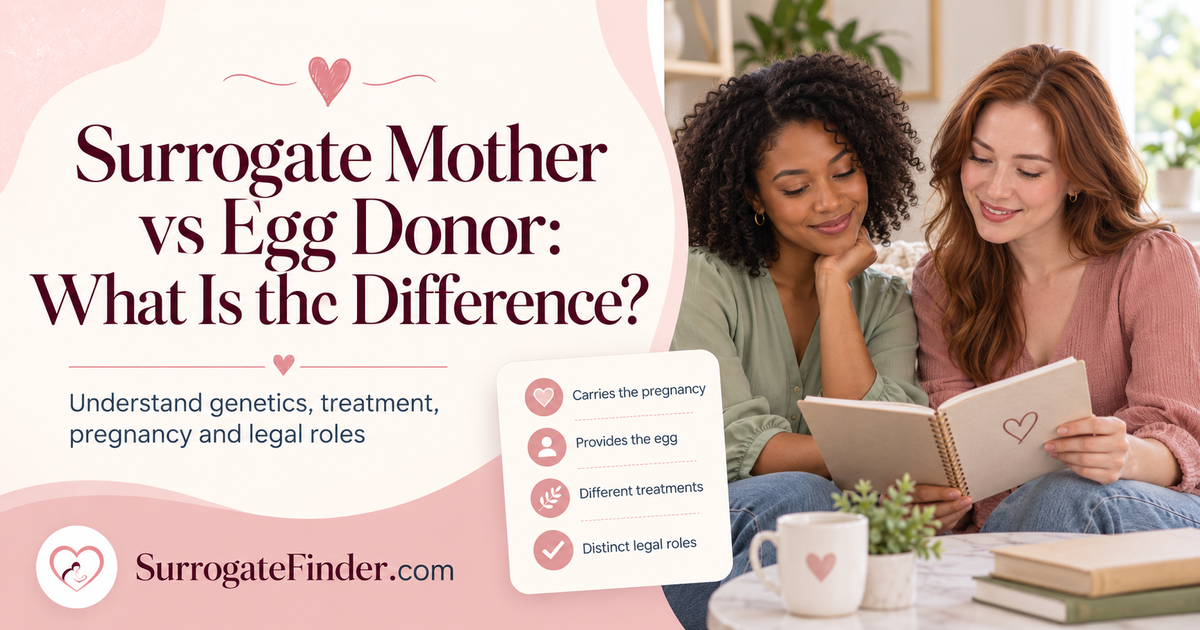
A surrogate mother and an egg donor can both help someone build a family, but they perform very different roles. A surrogate carries and gives birth to a baby. An egg donor provides eggs that may be fertilised to create embryos.
In gestational surrogacy, the surrogate does not provide the egg and has no inherited genetic connection to the baby. If donated eggs are used, the egg donor provides genetic material but does not carry the pregnancy.
The distinction affects medical treatment, time commitment, screening, legal planning, compensation or expenses and the possible future relationship between participants. Understanding each role helps intended parents, potential surrogates and potential donors decide which path fits their circumstances.
Surrogate mother vs egg donor at a glance
- Main role: A surrogate carries a pregnancy; an egg donor provides eggs.
- Genetic connection: A gestational surrogate has none; an egg donor is genetically related to a child born from her eggs.
- Medical process: A gestational surrogate prepares for embryo transfer; an egg donor undergoes ovarian stimulation and egg retrieval.
- Pregnancy: The surrogate may be pregnant for around nine months; the egg donor does not carry the resulting pregnancy.
- Legal position: Laws depend on location and how treatment is arranged.
- Future contact: Expectations and information rights vary by arrangement and jurisdiction.
A single journey may involve both a surrogate and an egg donor, as well as intended parents and a sperm provider. Each person has a distinct biological, medical and legal role.
What does a surrogate mother do?
A surrogate carries a pregnancy for another person or couple. She attends medical appointments, undergoes treatment or insemination, experiences pregnancy and gives birth.
There are two main types of surrogacy:
- Gestational surrogacy: An embryo created using an intended parent’s or donor’s egg is transferred to the surrogate. Her own egg is not used.
- Traditional surrogacy: The surrogate’s own egg is fertilised, so she is genetically related to the baby.
Most comparisons between a surrogate and an egg donor refer to gestational surrogacy, where pregnancy carrier and egg provider are separate people. Read Traditional Surrogacy vs Gestational Surrogacy for a detailed comparison.
What does an egg donor do?
An egg donor provides eggs for another person’s fertility treatment. She takes medication to stimulate her ovaries so that several follicles may develop during one cycle. The clinic monitors her response through scans and sometimes blood tests before collecting the eggs.
Collected eggs may be fertilised with sperm from an intended parent or donor. Resulting embryos may then be transferred to an intended mother or gestational surrogate, frozen for later treatment or, with appropriate consent, used in another permitted way.
The egg donor does not become pregnant as part of donation and does not give birth to the resulting child. However, because her eggs are used, she contributes inherited genetic material.
Who is genetically related to the baby?
An egg normally provides approximately half of an embryo’s nuclear DNA and also supplies mitochondrial DNA. A sperm provider normally supplies approximately the other half of the nuclear DNA.
An egg donor is therefore genetically related to a child conceived from her donated egg. A gestational surrogate does not provide the egg, so she does not contribute inherited DNA. Her body provides the environment in which the embryo develops.
A traditional surrogate is the exception: because her own egg is used, she is both the pregnancy carrier and a genetic parent. This is why it is important to confirm the type of surrogacy rather than relying only on the words “surrogate mother.”
For more detail about pregnancy and genetics, see Does a Surrogate Mother Share DNA With the Baby?
Can one woman be both the surrogate and egg provider?
Yes, but that arrangement is traditional surrogacy rather than gestational surrogacy. The woman’s egg is fertilised and she also carries the resulting pregnancy.
In gestational surrogacy, the two roles must be separate because the surrogate’s own egg is not used. The egg may come from an intended mother or a separate donor.
Traditional surrogacy may create additional emotional and legal considerations because the surrogate has a genetic connection to the child. Some clinics, agencies and jurisdictions do not support it. Everyone involved should obtain counselling and independent legal advice before conception.
How the medical procedures differ
The egg donor completes the egg-producing and retrieval stages of IVF. A typical process can involve:
- Initial consultation and eligibility assessment
- Medical, infectious-disease and family-history screening
- Counselling and written consent
- Daily hormone injections for ovarian stimulation
- Monitoring scans and blood tests
- A trigger injection when follicles are ready
- Egg collection using pain relief, sedation or anaesthesia
- Short-term recovery and follow-up
A gestational surrogate usually takes medication to prepare the lining of her uterus for embryo transfer. A clinician places an embryo into the uterus using a thin catheter. If implantation succeeds, she proceeds through pregnancy, antenatal care and birth.
The egg donor’s treatment is shorter but includes ovarian stimulation and an invasive retrieval procedure. The surrogate’s fertility treatment may be less invasive, but pregnancy and birth create a much longer physical commitment and carry pregnancy-related risks.
How long does each commitment take?
Egg donation may take several weeks to a few months from initial contact through consultation, screening, counselling, treatment and egg collection. The active medication and monitoring stage is usually concentrated within part of one menstrual cycle, although exact schedules vary.
A surrogacy journey is much longer. Matching, screening, legal preparation and treatment can take months before pregnancy begins. A successful pregnancy then lasts around nine months, followed by birth recovery and any agreed post-birth contact.
Intended parents should allow for possible delays, cancelled cycles or unsuccessful embryo transfers. Neither an egg collection nor an embryo transfer guarantees a baby.
Screening requirements
Both roles require medical and psychosocial screening, but the focus differs.
An egg donor may be assessed for:
- Age and ovarian health
- Personal and family medical history
- Infectious diseases
- Relevant inherited conditions
- Response to fertility medication
- Understanding of consent and future information rights
A surrogate may be assessed for:
- Previous healthy pregnancy and birth history
- General health and suitability for another pregnancy
- Medical conditions and current medication
- Lifestyle factors and support network
- Understanding of pregnancy, treatment and potential complications
- Emotional readiness and family circumstances
Clinic, agency and legal requirements vary. Passing an online eligibility checklist does not replace an individual clinical assessment.
Physical risks and recovery
Egg-donation medication can cause temporary effects such as bloating, headaches, nausea, mood changes or injection-site discomfort. Egg retrieval may cause soreness, cramping or bruising. Ovarian hyperstimulation syndrome is an uncommon but potentially serious reaction that requires prompt medical assessment.
A surrogate faces the risks associated with embryo transfer, pregnancy and birth. These can include miscarriage, ectopic pregnancy, gestational diabetes, high blood pressure, pre-eclampsia, caesarean birth, haemorrhage and other complications. Individual risk depends on health and pregnancy history.
Clinics should explain likely side effects, warning signs and emergency contact arrangements before treatment. No participant should begin medication obtained informally or proceed without appropriate medical supervision.
Emotional considerations
An egg donor may think about the possibility of genetically related children growing up in another family, whether her own partner or children should know and whether contact could occur in the future. Consumer DNA matching also makes permanent anonymity increasingly difficult even where arrangements were originally described that way.
A surrogate experiences pregnancy and birth for another family. She may develop a close relationship with the intended parents, manage public questions about the pregnancy and consider what contact will continue after birth.
These experiences are different, but both deserve careful preparation. Independent counselling helps participants explore expectations without pressure and consider how the decision may affect their family over time.
Legal rights and parenthood
Genetic connection, pregnancy and legal parenthood are separate concepts. The rules depend on where treatment takes place, where participants live, how conception occurs and where the child is born.
When eggs are donated through a licensed UK fertility clinic, the donor has no legal rights or responsibilities for children born from the donation. Treatment outside a licensed clinic or in another country may produce different legal consequences.
Under current UK rules, a surrogate is the legal parent at birth even when she is a gestational surrogate with no genetic relationship to the baby. Intended parents generally need a parental order or adoption to transfer legal parenthood. Other jurisdictions may use pre-birth or post-birth orders.
Each participant should obtain independent specialist legal advice before treatment. A private agreement or genetic test should never be assumed to settle parenthood automatically.
Identity, anonymity and future contact
Rules about donor information vary internationally. In the UK, egg donation through licensed clinics is not anonymous to donor-conceived adults: identifying information may be requested from the HFEA when they reach 18. Non-identifying information can become available earlier.
A donor does not have to form a relationship if contacted, but should understand that future contact is possible. Home DNA databases may also identify donors or genetic relatives outside formal systems.
Surrogacy usually involves direct communication before and during pregnancy. The intended parents and surrogate should discuss the kind of relationship they hope to maintain after birth, while recognising that circumstances and a child’s needs may change.
Compensation and expenses
Payment rules differ widely. In the UK, commercial payment for surrogacy is restricted and a surrogate may receive reasonable expenses. The court considers payments when deciding a parental-order application.
UK egg donors cannot be commercially paid, but may receive compensation within the amount set by the HFEA and may be able to claim higher documented expenses in some circumstances. Other countries and US states use different models and limits.
Compensation should not be confused with the total amount intended parents may pay. Clinic treatment, medication, legal advice, insurance, travel and administration can make the overall cost substantially higher.
All financial arrangements should be transparent, documented and reviewed by appropriate professionals before treatment begins.
Who might consider becoming a surrogate?
A woman may consider surrogacy because she has enjoyed pregnancy, wants to help another family and feels able to make the time and emotional commitment. Many programmes expect a surrogate to have previously experienced a healthy pregnancy and birth.
She should consider how treatment, pregnancy, travel, appointments, possible bed rest, birth recovery and the intended-parent relationship would affect her household and employment.
Potential surrogates can browse intended-parent profiles on SurrogateFinder and learn about the people hoping to build a family.
Who might consider becoming an egg donor?
A woman may consider egg donation because she wants to help an individual or couple who cannot conceive using their own eggs. Donors may be known to recipients or matched through a clinic, egg bank or another permitted route.
She should be comfortable with fertility medication, monitoring appointments, egg collection and the possibility of genetically related children. Age and health requirements vary by clinic and country.
Women interested in donation can review egg donor profiles and matching options to understand how intended parents describe their search.
What intended parents should consider
Some intended parents need a surrogate, some need an egg donor and some need both. The answer depends on whether an intended parent can carry a pregnancy and whether suitable eggs are available.
- If an intended mother can produce eggs but cannot safely carry, a gestational surrogate may be required.
- If an intended mother can carry but cannot use her own eggs, an egg donor may be required.
- If neither carrying nor using an intended parent’s eggs is possible, both an egg donor and gestational surrogate may be involved.
- Single men and male couples commonly need an egg provider and a surrogate.
A fertility specialist can assess medical options and explain whether donated eggs, surrogacy or another treatment is appropriate.
Can the egg donor and surrogate know each other?
They can, depending on participant preferences, clinic policy and local rules. In some journeys the egg donor is a friend or relative, while the surrogate is matched separately. In others, both are previously unknown to the intended parents.
Known arrangements can offer openness but also require clear boundaries. Participants should discuss privacy, direct contact, medical information, the future child and what happens if relationships change.
No one should share sensitive identifying or medical information until comfortable with the platform, professionals and safeguards involved.
Finding the right person safely
Online profiles can help people discover potentially compatible matches. Intended parents may find surrogate mothers or browse egg donors according to the support they need.
Before proceeding, verify identity, discuss expectations carefully and involve a fertility clinic and independent lawyers. Do not send large payments merely because someone appears suitable online.
SurrogateFinder is a matching platform rather than a fertility clinic, surrogacy agency or legal adviser. A profile introduction is the beginning of due diligence, not approval of a medical or legal arrangement.
Frequently asked questions
Is an egg donor the same as a surrogate?
No. An egg donor provides eggs, while a surrogate carries a pregnancy. In gestational surrogacy they are separate people.
Does a surrogate mother use her own eggs?
A gestational surrogate does not use her own eggs. A traditional surrogate does, making her genetically related to the baby.
Does an egg donor carry the baby?
No. The donor’s eggs are collected and may be used to create embryos. An intended mother or gestational surrogate carries the resulting pregnancy.
Who is biologically related to the baby?
The egg and sperm providers contribute inherited DNA. A gestational surrogate supports the pregnancy but does not contribute inherited DNA.
Which process is longer?
Surrogacy is normally the longer commitment because it includes preparation, pregnancy, birth and recovery. Egg donation usually concludes after ovarian stimulation, retrieval and follow-up.
Can intended parents use both an egg donor and surrogate?
Yes. An embryo can be created using a donated egg and then transferred to a gestational surrogate.
Does an egg donor have parental rights?
That depends on the law and treatment route. A donor using a licensed UK clinic has no legal parental rights or responsibilities, but private and overseas arrangements require specific legal advice.
Can a donor-conceived child contact the egg donor?
Possibly. Information-access rules depend on the country and treatment date. In the UK, people conceived through donation at a licensed clinic can request identifying donor information at age 18 under current rules.
Take the next step
The simplest distinction is that a surrogate carries the pregnancy and an egg donor provides genetic material through her eggs. In a gestational-surrogacy journey, both women may help create the same family while contributing in fundamentally different ways.
When you are ready to explore compatible matches, create your free SurrogateFinder profile and connect through the platform’s private messaging system.
This article provides general information and is not medical or legal advice. Fertility treatment, donation, surrogacy and parentage rules differ by location and may change. Consult a qualified clinic and independent specialist lawyer before proceeding.