
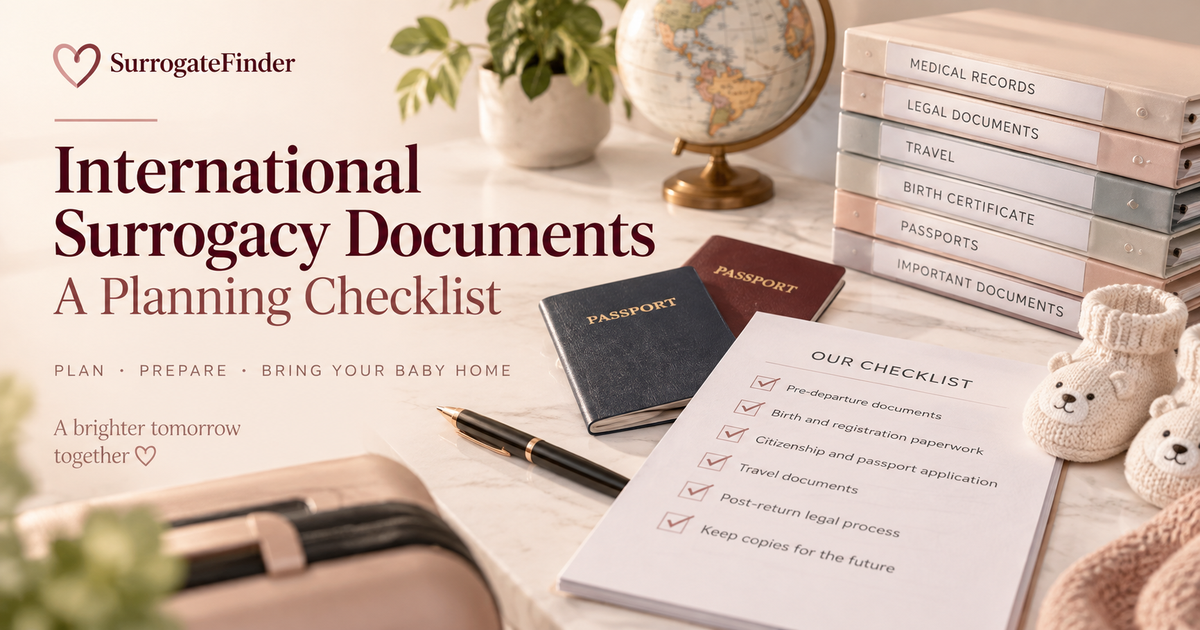
International surrogacy can generate a large amount of paperwork. Intended parents may need documents from fertility clinics, lawyers, courts, hospitals, civil registries, surrogacy agencies, passport authorities and embassies — sometimes in more than one language.
The exact documents required depend on the countries involved and your circumstances. There is no universal international surrogacy document pack. This checklist is therefore a planning tool: confirm the exact requirements with independent lawyers and the relevant authorities before treatment and again before the birth.
International Surrogacy Documents: The Quick Checklist
- Intended-parent identity and citizenship records.
- Marriage or civil-status documents where relevant.
- The surrogate's identity and marital-status records where required.
- The signed surrogacy arrangement.
- Clinic, treatment and embryology records.
- Pre-birth or post-birth court orders.
- The baby's birth registration and birth certificate.
- Surrogate consent for passport applications and travel where required.
- Citizenship and nationality evidence.
- Passport or other travel-document applications.
- DNA evidence where formally requested.
- Translations, notarisation, legalisation or apostilles where required.
- Post-return legal-parenthood documents.
Documents to Organise Before Treatment Begins
Good document planning starts before embryo transfer. Keep current passports and official birth certificates readily available. Depending on the case, you may also need marriage certificates, civil-partnership certificates, divorce documents or evidence showing how an intended parent acquired citizenship or met residence requirements.
The Surrogacy Agreement
Keep the complete signed surrogacy agreement and any amendments. UK overseas-surrogacy guidance specifically lists documentation about the surrogacy arrangement, including signed legal agreements, among records that may be required for a British passport application.
Legal and Court Records
Keep copies of local court filings and any pre-birth orders available in the country of birth. A foreign order can be important evidence even where it does not automatically determine parenthood at home.
If you are still deciding where to undertake the journey, read what intended parents should consider before choosing a country for international surrogacy.
Fertility Clinic and Embryology Records
Clinic records can become important evidence in citizenship, passport or parentage processes. Retain treatment confirmation, procedure and embryo-transfer records, relevant records showing whose gametes were used, donor documentation where appropriate, embryology records and useful clinic correspondence.
UK guidance says medical evidence of fertility treatment and/or documentation from the surrogacy organisation may be required. US authorities may request evidence concerning conception and birth and genetic or gestational connections.
Documents to Confirm During Pregnancy
During pregnancy, confirm how the birth will be registered, who is expected to appear on the birth certificate, whether a local court order is needed, what the surrogate must sign, whether her spouse is involved, which citizenship/passport route is expected and which documents will need certified translation.
For the wider journey, see how long the surrogacy process takes.
What to Take When You Travel for the Birth
Carry the essential originals or certified copies your advisers tell you to bring and keep secure digital backups separately. Your travel file may include passports, birth and marriage certificates, the surrogacy agreement, clinic and embryology evidence, relevant court orders, professional contact details and embassy or consulate appointment information.
Documents to Obtain After the Baby Is Born
Birth Certificate
Obtain the official local birth certificate and certified copies where available. Check names, dates and places carefully before using it in later applications.
Local Court Orders
If the country of birth provides a post-birth parentage process, obtain certified copies of the resulting order. Recognition of foreign orders varies between countries.
Surrogate Consent Documents
Some passport and travel processes require written consent from the surrogate and, depending on the circumstances, her spouse. UK guidance distinguishes consent for passport/travel arrangements from consent to a later parental order.
Citizenship and Passport Documents
Common evidence can include the baby's birth certificate, intended-parent identity and citizenship records, evidence supporting the child's nationality claim, clinic records, surrogacy documentation, court orders, relevant surrogate documents, residence or physical-presence evidence and formally requested DNA evidence.
See Citizenship and Passports After International Surrogacy for the UK and US routes in more detail.
UK Intended Parents: Document Checklist
Current UK guidance says an overseas British passport application involving surrogacy may require:
- Signed documentation about the surrogacy arrangement.
- Medical evidence of fertility treatment and/or documentation from the surrogacy organisation.
- Relevant foreign pre-birth or post-birth court orders.
- Consent from the surrogate and, where relevant, her husband.
- Documentation confirming the surrogate's identity and marital status.
- The child's birth certificate.
- Proof of the child's claim to British nationality.
- Proof of the intended parent or parents' identity.
- Marriage or civil-partnership evidence where relevant.
HM Passport Office also asks for a covering letter explaining the surrogacy circumstances. If a parental order has already been granted, the order and the child's post-order birth certificate may also be relevant.
US Intended Parents: Document Checklist
The US Department of State says that in surrogacy cases it may request evidence of the child's conception and birth, genetic or gestational connections, the parents' identity and citizenship, the relevant US citizen's physical presence or residence in the United States before birth, and legal status as the child's parent under local law.
Check with the relevant US embassy or consulate for the full requirements. Where DNA evidence is requested, follow the official testing process.
Translations, Notarisation, Legalisation and Apostilles
An original document from one country is not automatically ready for use in another. The receiving authority may require a certified translation, notarisation, legalisation or an apostille. These are different processes, so confirm exactly what is required before paying for document preparation.
Originals, Certified Copies and Digital Backups
- Originals and official certified copies for authorities that require them.
- Working paper copies for appointments and reference.
- Secure digital backups in case paperwork is lost while travelling.
Keep sensitive files secure because they may contain passports, addresses, medical information and other personal data.
Documents for the Journey Home
Before travelling, confirm that the baby has the passport, visa, entry clearance or other documentation required for the destination. Keep the baby's birth certificate, travel document and relevant supporting paperwork accessible during the journey.
For the full post-birth process, read Bringing a Baby Home After International Surrogacy.
Documents to Keep After Returning Home
Keep the final surrogacy agreement, clinic and embryology records, birth certificates, foreign court orders, citizenship and passport records, consent documents, certified translations and relevant legal correspondence securely.
UK intended parents should remember that an overseas birth certificate, court order or British passport does not itself complete the UK legal-parenthood process. Where eligible, intended parents generally need a parental order.
Common Document Mistakes to Avoid
- Waiting until birth to investigate paperwork.
- Assuming the foreign birth certificate is enough.
- Carrying only one copy of important records.
- Using the wrong translation or authentication format.
- Arranging unofficial DNA testing.
- Confusing travel consent with parental-order consent.
- Discarding records after returning home.
Master International Surrogacy Document Checklist
- Current intended-parent passports.
- Intended-parent birth certificates.
- Relevant civil-status records.
- Citizenship and residence evidence where required.
- Complete signed surrogacy agreement.
- Clinic treatment confirmation.
- Embryology/genetic-source evidence where relevant.
- Required surrogate identity and marital-status evidence.
- Pre-birth orders where applicable.
- Hospital birth records.
- Official local birth certificate and certified copies.
- Post-birth orders where applicable.
- Surrogate passport/travel consent where required.
- Citizenship application records.
- Passport/travel-document records.
- DNA evidence if formally requested.
- Visa or entry-clearance documents if required.
- Certified translations.
- Notarised, legalised or apostilled documents where required.
- Home-country parental-order, adoption or parentage paperwork.
Budget for the Paperwork Too
Costs can include certified copies, translations, notarisation, apostilles, legalisation, court fees, lawyers, couriers and additional accommodation while applications are processed. See International Surrogacy Costs: What Should Intended Parents Budget For?.
Finding Support for an International Journey
SurrogateFinder is a matching platform rather than a law firm, immigration adviser, medical provider or surrogacy agency. Intended parents still planning a journey can browse surrogate mothers, find surrogacy agencies and explore fertility clinics.
Related SurrogateFinder Guides
- Citizenship and Passports After International Surrogacy
- Bringing a Baby Home After International Surrogacy
- International Surrogacy: What Intended Parents Should Consider Before Choosing a Country
- International Surrogacy Costs: What Should Intended Parents Budget For?
- U.S. Surrogacy for International Intended Parents
- What Happens After a Surrogate Gives Birth?
Frequently Asked Questions
What documents do intended parents need for international surrogacy?
Requirements vary, but commonly relevant records include identity and citizenship documents, the surrogacy agreement, clinic records, birth records, court orders, consent documents and passport or immigration evidence.
Should I take original documents abroad?
Ask your lawyer and the receiving authorities which originals or certified copies are required. Keep essential documents securely in hand luggage and maintain separate secure backups.
Do surrogacy documents need to be translated?
Often, but requirements vary. Check whether the receiving authority requires a certified translation, notarisation, legalisation or an apostille.
Is a foreign birth certificate enough to bring a baby home?
Not necessarily. The child may also need citizenship evidence, a passport or other travel document, and sometimes a visa or entry clearance.
Can DNA evidence be required?
Yes, in some cases where a genetic relationship is relevant to citizenship or travel documentation. Use the official testing procedure requested by the authority.
Should we keep the paperwork after returning home?
Yes. Records may be needed for legal parenthood, future passports, citizenship matters and your child's long-term personal history.
Important Note
This article provides general information and is not legal, immigration, nationality or medical advice. Document requirements vary by country and case and can change. Confirm current requirements with qualified advisers and the relevant authorities.